
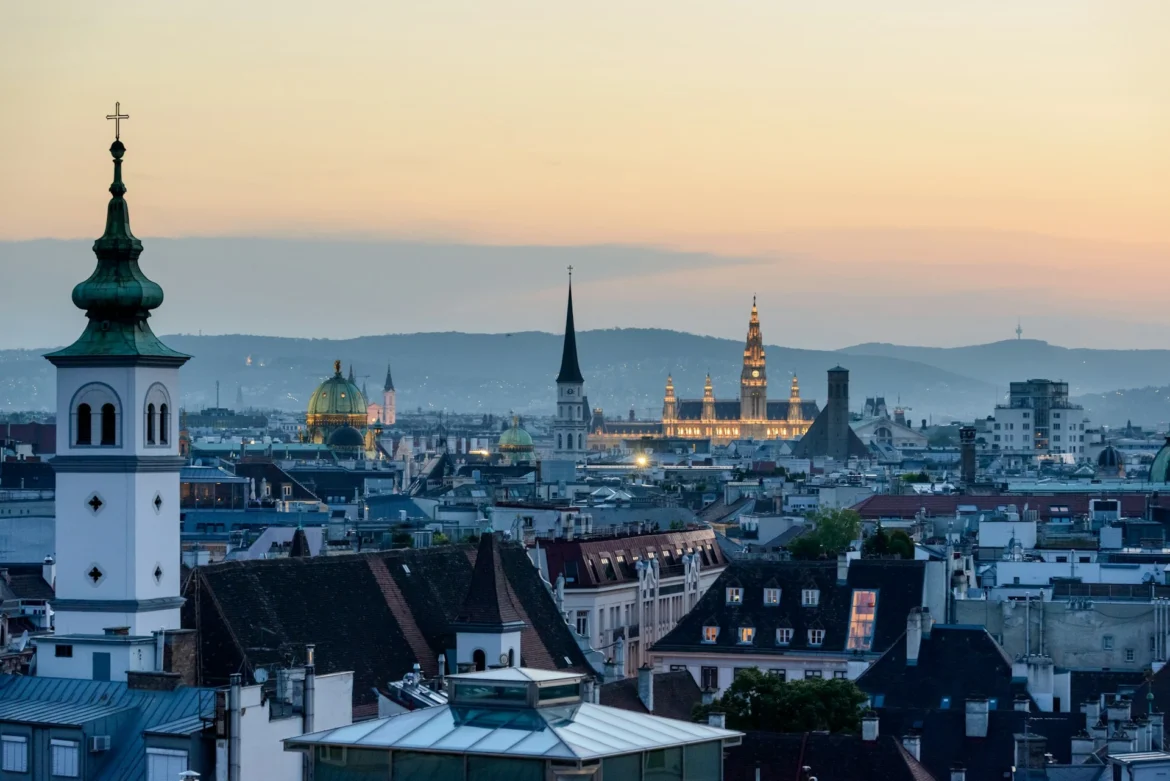
Vienna doesn’t ease you in. It hits immediately — the Ringstraße, the Staatsoper, the weight of Habsburg history pressing down on every cobblestone. For travelers who want their city breaks to actually mean something, this is where to start.
Europe’s great cities have always rewarded people who show up prepared. Not with a checklist, but with genuine curiosity — and a willingness to slow down long enough to let a place reveal itself.
Here are five that do it better than anywhere else.
Vienna
The former Habsburg capital is built for the intellectually restless. That monumental circular boulevard — the Ringstraße — tells you everything about the city’s ambitions: Historicism at full volume, unapologetic and grand. Catch a performance at the Staatsoper or the Musikverein and you’re experiencing acoustic traditions refined over literal centuries.
Then there’s the art. The Belvedere holds Klimt’s Symbolist work. The Kunsthistorisches Museum runs from Bruegel’s Northern Renaissance scenes straight through European power and thought. Two institutions. Entire lifetimes of material.
Paris
Everyone sentimentalizes Paris. The trick is to skip that entirely.
The city’s real character lives in the 6th and 7th arrondissements — independent bookshops, esteemed galleries, the lingering ghost of Enlightenment discourse. The Musée d’Orsay rewards slow, deliberate visits; the Musée Rodin, smaller and more intimate, is where modernity starts to make sense.
And the food. This isn’t about Michelin stars (though those exist). It’s about a culture that treats technique and terroir as genuinely serious subjects — an “art de vivre” where pleasure and critical thinking aren’t opposites.
Copenhagen
No Baroque excess here. Copenhagen works through restraint.
The Danish capital has built its reputation through the lens of sustainability and human-centric architecture — cities designed around people rather than monuments, materials chosen with environmental consequence in mind. The Louisiana Museum of Modern Art, just north of the city, is the obvious example: a building in genuine dialogue with its landscape rather than imposed upon it.
The food culture tells the same story. Copenhagen didn’t just participate in the hyper-local, experimental cooking movement — it largely invented the language other cities now speak. Clarity of form. Environmental ethics. Quiet confidence. That’s the Danish proposition, and it’s a compelling one.
Rome
Rome is layered. Republican. Imperial. Papal. Baroque. Each era stacked on the last, occasionally crumbling into the next. A cursory glance at the Colosseum barely scratches it.
Go to the Villa Borghese for Bernini’s sculptures — the marble genuinely looks like it’s moving. Find the Caravaggios tucked inside San Luigi dei Francesi. These are the moments that make the city worth the chaos.
For those wanting immersion without exhaustion, a luxury retreat in Rome changes the experience entirely. When you have somewhere genuinely serene to return to, you engage with the city differently — more analytically, less frantically. The Eternal City rewards that kind of attention. A luxury retreat in Rome gives you the vantage point to actually appreciate the synthesis of ancient grandeur and modern vitality rather than just surviving it.
Zurich
People overlook Zurich. That’s their loss.
Yes, it’s precise. Yes, the financial reputation precedes it. But this is also the city where Dadaism was born — at the Cabaret Voltaire, in 1916, as an act of deliberate artistic subversion. That undercurrent hasn’t entirely disappeared.
The Kunsthaus Zurich holds one of the strongest Modernist collections in Europe. The Bahnhofstrasse offers retail at its most curated and uncompromising. And the geography does something genuinely unusual: you can move from urban intellectualism to Alpine landscape inside an hour. For travelers who want both efficiency and the sublime, that’s a rare combination.
Which city wins? Depends entirely on what you’re after. Imperial weight and musical heritage — Vienna. Aesthetic rigor and sustainable urbanism — Copenhagen. Ancient complexity with modern elegance — Rome.
The point isn’t to rank them. It’s that all five reward the attentive visitor in ways that faster, noisier trips simply don’t.