
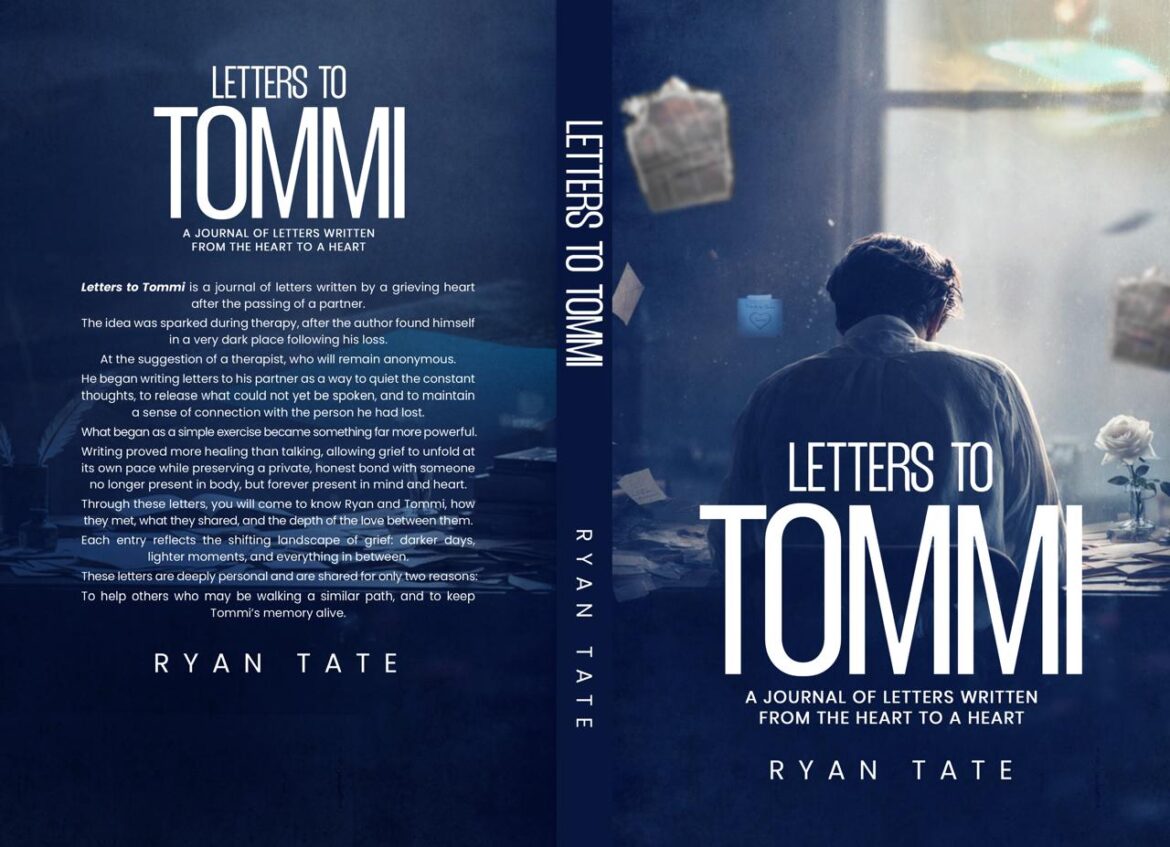
Some books begin with a publishing plan, while others begin with a need to survive a difficult moment. Letters to Tommi belongs firmly to the second category, emerging from Ryan Tate’s personal attempt to process the death of his partner through writing.
The project began after Tate found himself struggling during bereavement and discussed his situation during therapy. A suggestion from his therapist led him towards writing directly to Tommi, giving thoughts somewhere to go when speaking about them proved difficult.
What started as a therapeutic exercise gradually developed into something much larger. The resulting collection preserves memories, conversations, private observations, and fragments of a relationship that Tate did not want time to erase.
A Relationship Told Through Small Things
Rather than constructing its story entirely around major milestones, the book frequently turns towards the details that might otherwise disappear from memory. Food, clothing, television, exercise, household routines, humour, expressions, photographs, and small written messages become evidence of how two people actually lived together.
This approach gives the collection a distinctly personal character. Readers encounter Tommi not simply through descriptions of his importance, but through the habits and behaviours that made him recognisable to the person who knew him most closely.
Among the most distinctive objects are the small blue notes Tommi wrote in Finnish and concealed in places where Ryan would eventually discover them. Their significance changes after Tommi’s death, because each remaining note becomes both a physical object from their shared life and an unexpected encounter with the person who wrote it.
Between Britain and Finland
The relationship also developed across national boundaries, bringing a practical dimension to their personal story. Tommi was Finnish and lived in Finland, while Ryan is British, meaning that distance, travel arrangements, residence restrictions, careers, and family commitments became part of the reality surrounding their relationship.
Their plans were therefore not simply romantic hopes. They involved finding workable ways to spend more time together, discussing where they might eventually live, considering legal partnership, and thinking about how they could build a future despite administrative obstacles.
The book presents these circumstances from the perspective of someone experiencing the bureaucracy personally. The relationship becomes an example of how international partnerships can involve emotional commitment alongside complicated practical decisions.
A Portrait Built From Memory
There is also something unusual about the way Tate records personality. Humour remains present even within painful memories, particularly when he recalls Tommi’s distinctive vocabulary, mannerisms, reactions, and occasionally accident-prone behaviour.
These recollections prevent the portrait from becoming entirely solemn. Tommi is remembered as a person with quirks, habits, preferences, frustrations, affection, and humour, which makes the collection feel closer to remembering a real individual than constructing an idealised memorial.
That distinction matters because memories after bereavement can easily become simplified. Tate instead appears interested in preserving the particular qualities that made Tommi recognisable to him, including the characteristics that might seem insignificant to anyone outside their relationship.
The Importance of Shared Rituals
Food provides another revealing window into their life together. Tommi cooked regularly, while Sundays gave Ryan an opportunity to prepare a traditional British roast, creating a simple exchange of responsibility within their household.
The significance of such routines extends beyond the activity itself. Preparing food, sharing a sofa, watching television, exercising, travelling, and communicating through small notes all become records of companionship that existed before grief changed their meaning.
These moments show how relationships are often documented without anyone deliberately keeping a record. A meal can become a memory, a kitchen can become a reminder, and an ordinary Sunday can eventually represent an entire period of shared life.
Writing as a Way of Speaking
The book’s unusual form is central to its identity. Tate does not write about Tommi from a distant perspective throughout the collection; instead, he frequently writes directly to him, maintaining the second-person conversation that gives the work its intimate character.
That decision allows the writing to retain the immediacy of personal correspondence. Questions can be asked, memories can be recalled, affection can be expressed, and thoughts can be directed towards someone who is no longer physically available to receive them.
The letters therefore function on two levels. They preserve information about the relationship while also showing the changing emotional experience of the person doing the writing.
A Non-Linear Record
The collection does not follow a conventional chronological structure. Tate explains that the letters were written according to whatever thought, memory, or emotion was most prominent at the time, meaning that readers encounter the relationship through recollection rather than through a strictly ordered timeline.
This gives the book the quality of an evolving personal archive. One memory can lead to another, while a domestic detail can sit beside a major event, reflecting the unpredictable way people remember someone who has died.
For a reader, this structure also creates the sense of entering someone’s private thought process. The collection is less concerned with constructing a perfectly controlled narrative and more concerned with preserving what mattered when each letter was written.
A Record Shared With Others
Although the material is intensely personal, Tate gives the writing a wider purpose. The book was not created only to preserve Tommi’s memory, but also to reach people who may recognise aspects of their own experiences in the uncertainty and complexity of bereavement.
That intention is reflected in the direct acknowledgement that different readers may approach difficult material at different stages. The collection therefore attempts to create space for individual responses rather than suggesting that there is one correct way to experience loss.
This makes the book more than a private memorial. It becomes an invitation for readers to consider their own memories, relationships, and methods of coping with absence.
Preserving More Than a Person
The most distinctive achievement of Letters to Tommi is its attempt to preserve an entire atmosphere surrounding a relationship. It records not only who Tommi was, but also how the couple communicated, what they cooked, where they travelled, how they planned, what made them laugh, and which objects became meaningful.
In doing so, the book demonstrates how memory operates through accumulation. No single photograph, conversation, meal, note, or story can represent an entire relationship, but together these fragments can create a remarkably detailed impression of a shared life.
Tate’s writing ultimately turns personal recollection into a form of documentation. The result is a record intended to ensure that Tommi remains present not through an idealised image, but through the collection of ordinary details that made him uniquely himself.
About the Author
Ryan Tate is the author of Letters to Tommi, a personal collection that developed from therapeutic writing following the death of his partner. Through the book, he documents their relationship, preserves memories of Tommi, and extends the private process of writing into a work intended to connect with other readers.
Website: letterstotommi.com